JORDAN BRAND’S FUTURE, a designer’s point of view
With Nike stocks and prestige facing a constant drop in the last few years, retro products hugely overselling performance products, lifestyle market progressively dismissing basketball styles and Air Jordans losing their benchmark status in performance basketball landscape, Jordan Brand’s future looks uncertain.
As a footwear designer and creative direction consultant, here is my take on the current situation and about some of the ways it could be faced.

1. A picture of myself (...), with proper fortune-teller equipment and dress, tryng to predict Jumpman’s brand future 😂
Recently, Nike and Jordan news are consistently flooding social media feeds and, big part of the times, not for the best reasons.
In particular, some of these posts made me reflect on Jordan Brand current status.
Adding piece by piece, I’ve been kinda pushed to write this article...these are some of the “inspirations” that led me to the subsequent conclusions:
I’ve read an instagram post by @frontepageaaron stating Jordan lifestyle products planetary success is actually hiding/diminishing latest performance products functional value because the Brand is now considered by people to be part of luxury/casual category, almost losing tracks of its original performance roots; while not completely agreeing with it (more on this later), it was an interesting take nonetheless.
Jordan Brand launched a global contest for young designers to reimagine the Air Jordan 1 in a more contemporary style. All selected creations (probably according to Jordan Brand’s contest specific briefs) were pure fashion designs, having nothing to do with performance and technical innovation, but also without any reference to original brand DNA.
During Air Jordan 41 presentation (in this Nick Engvall’s interview on Sneaker History website), Donald Kelsey, Jordan Brand’s Senior Director of Basketball and Promo Foootwear, clearly stated that the retro business had created “almost like a cloud over performance basketball”, somehow dictating and restricting performance models options in terms of creative freedom.
A few social network posts are referring about possible signs of retro market falling down, with reselling prices consistently dropping and even numbered Jordans remaining untouched on shop shelves or being unsold on web stores, until consistent discounts are applied.
In my personal experience I’m also noticing that most of early Air Jordans are becoming too hard for feet, too heavy and uncomfy by today’s standars, while more recent ones, as well as todays models (all performance models, not just Jordans) are also too stiff and restrictive, because of tougher functional demands.
So it’s becoming clear that rocking retros (made replicating 30+ years old technology, with worst materials and craftmanship) for a whole day is a far worse experience than wearing some re-engineered running classics or specific lifestyle models.
On the other hand, it’s also obvious that all these retro models are no more efficient as performance models, being easily overtaken by lighter, faster, more cushioned and resposive current models, also granting same or higher level of support, thanks to new materials and techs.
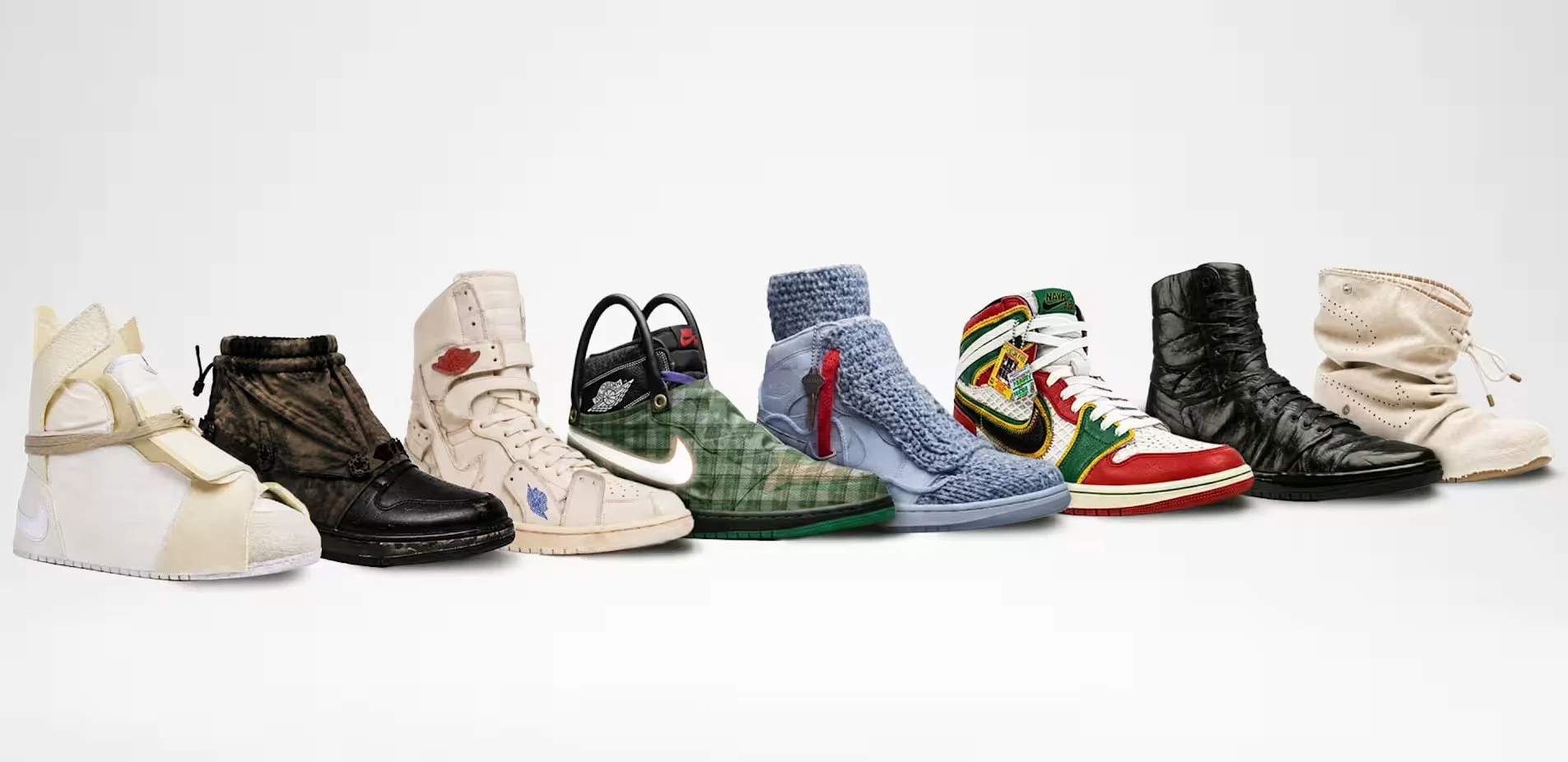
2. Jordan Design Studio contest selected finalists
I’ve always admired Air Jordan line and Jordan Brand’s evolution during the years, they are one of the reasons of my passion for footwear design, which also became a profession.
As well as Michael Jordan’s career was progressing on court, his shoes kept improving year after year.
In terms of design, the style evolved into a cleaner, more sophisticated and elegant one.
Performance wise, they kept an evolutionary approach, adding little innovations year after year, avoiding fall downs.
Branding on the shoes became minimal: as soon as the Jordan Brand’s DNA was solidifying, it was not necessary to slap a huge logo on the shoe to recognise it as an Air Jordan...you clearly knew it just watching the shoes at first sight!
Here in Italy we have incredible assets in terms of monuments, historical buildings, art masterpieces, natural beauties, food, etc, and we are all aware they have to be preserved in the best way and volorized as much as possible to be inherited by younger, upcoming generations.
For this reason I think Jordan Brand history and core values need to be protected and carried over in the future, also reassuring its further evolution will keep them intact for new breeds of sneaker enthusiasts and basketball players.
Here are some of the ideas I’ve put together in order to keep the Brand alive and solve some of the critical issues that are emerging in this age.
One brand, Two labels
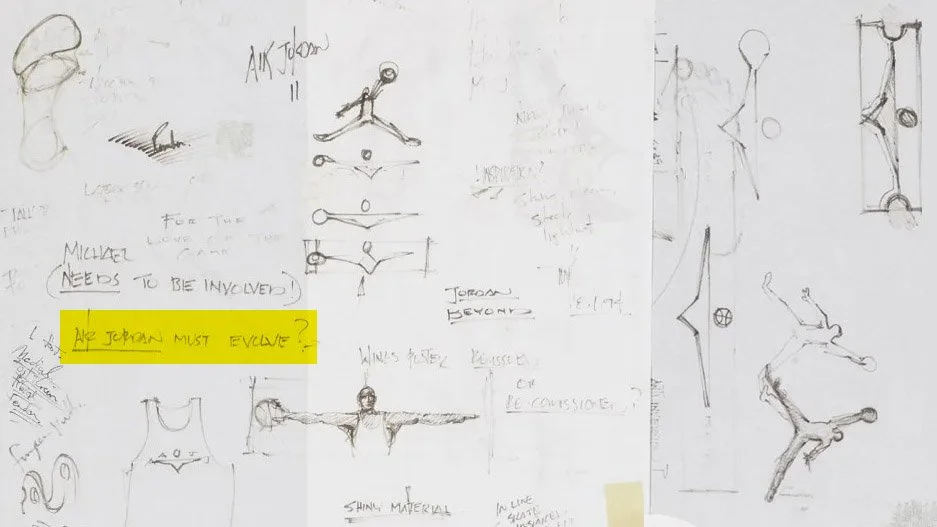
3. Tinker Hatfield’s hand written notes and sketches for Air Jordan 11 creation
Looking at the finalists of Jordan Design Studio contest (picture 2) and reading Donald Kelsey’s words (point #3 of my initial list), it’s clear that the retro-lifestyle side of the Brand is heading to a luxury/high fashion direction while performance side of the Brand needs to be uncaged from excessive nostalgic pressure, to be free to fly high in the “game-shoes” ranking.
Even though Jordan Brand already has different teams for lifestyle and performance departments, I think it could be necessary to separate them even more, creating two different labels:
the “Street line”, taking care of lifestyle models, new and retros, owning the Wing logo and Jumpman logo. Street name is kind of a straight forward name, but pays homage to Air Jordans’ vital role in the golden age of street culture, from mid ‘80s to mid/late ‘90s, and clearly states the purpouse of this branch of the Brand.
The “Game line”, dedicated to the performance models, ranging from the flagship model to signature models, to team shoes and also open to other sports performance products. Game Line will be identified with an exclusive New Logo. It’s name, also straight forward, is an homage the Michael Jordan’s “love of the game” contracts clause and also for the same “love of the game” reason for his second come back to the basketball with the Washington Wizards.
If you are shocked about the New Logo proposal for the Game line, have a better look to picture 3...In 1994/95, while setting up the foundations of Air Jordan 11, Tinker Hatfield already asked himself “Air Jordan must evolve?”, also studying different variations of a new logo based on the Wings poster.
In my opinion, a new logo might be a great inspiration to face the future without fear and with renewed enthusiasm in pushing the performance line to new boundaries.
The creation of two different labels isn’t a great innovation too.
Air Jordan 1 designer, Peter Moore, who was a real creative genius, after his departure from Nike, joined Adidas and was appointed to reorganize the company which, at that time, was struggling to reinvent itself, after his huge initial success.
Moore took time to study the company, noticing that new and reissued products were clashing each other, they were losing tracks of their historic value and lacking of a clear direction for future projects.
So he proposed to create two separate departments, Adidas Equipment, dedicated to performance products lines, and Adidas Originals, for sportswear line, including the proper reissue of older products. Needless to say that he also created a new logo for the Equipment line (the same we currently have), while leaving the historic “trefoil logo” to the Originals division.
So, it’s funny to think that Air Jordan 1 creator and Jordan line main architect could have already set up the guidelines to save Jordan Brand 30+ years ago!
Jordan Brand DNA and culture preservation and enpowerment
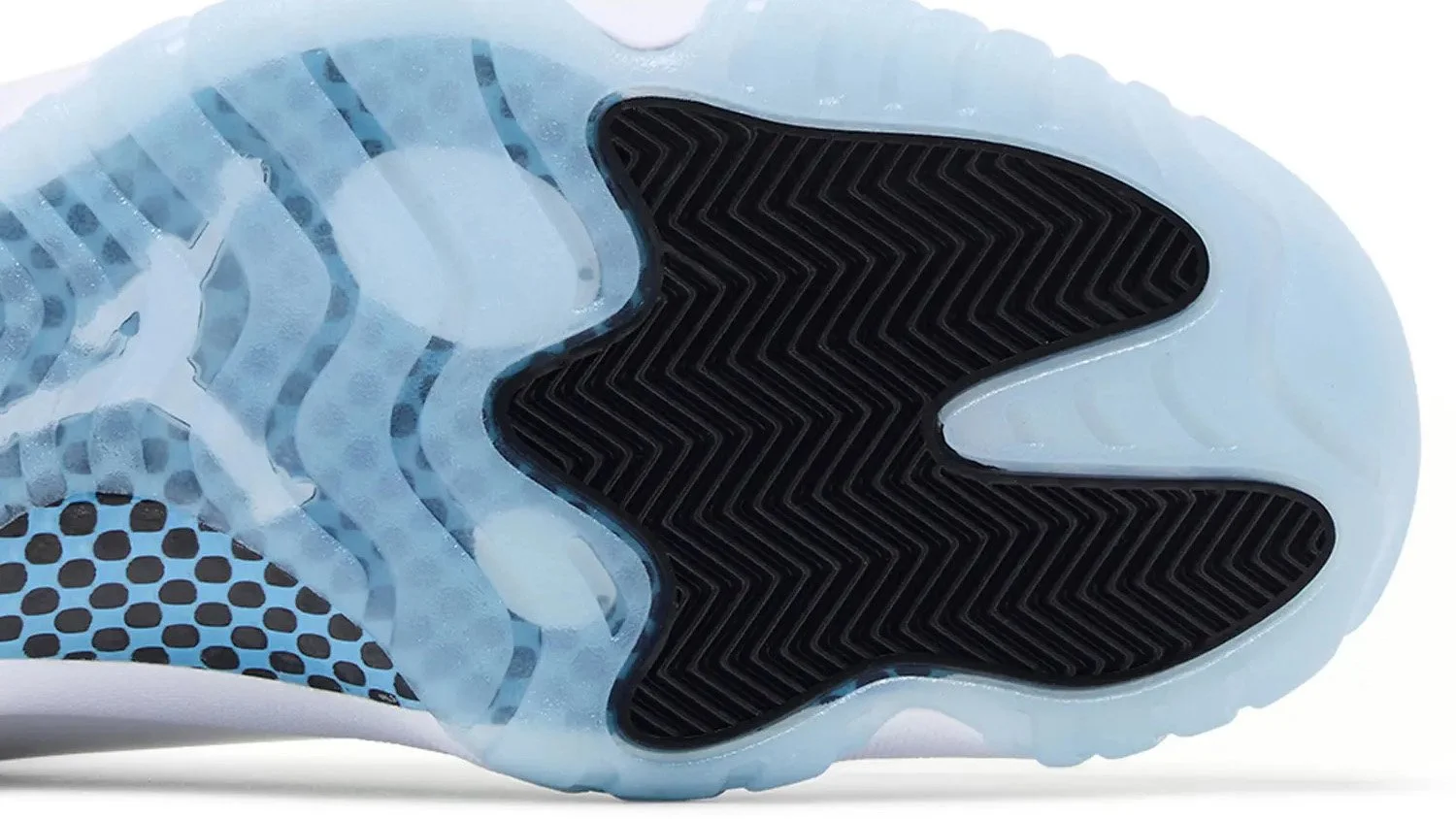
4. Air Jordan XI outsole - performance, tech and style
While thinking to preserve the Brand identity for the ages and make it strong and stronger in the upcoming products, it’s very important to define its DNA in the best way possible, to be clear to everyone creating new products and to stay clearly noticeable for those buying them.
Every employee should be brought inside this Culture, properly selected, introduced and instructed so that she/he will be ready to infuse it into her/his work.
In Jordan Brand’s case, everthing has necessarily to start with Michael Jordan.
He set the highest standards for his work and performance. His relentless competiveness is still unmatched. His style was unique, elegant but functional and efficient.
I think that new products, both from Street and Game lines, must respect this “vision” rather than desume an indirect version of Jordan Brand’s DNA from past products.
The DNA has to be the one and only source, to be sure that the innovation process will progress.
The DNA could be also used to preserve the Brand from releasing unappropriate products, lacking the proper amount of work in terms of style, quality, performance (for performance products), uniqueness, etc. Even lower budget products should hold their own against their direct competitors, just not thinking a Jumpman logo (or the new logo) would be enough to compensate a lazy execution.
Many times I’ve heard the story that when a father buys a Jordan product to a son as a reward, a slightly higher price point could be considered as a way to introduce the son into a culture of hard work leading to excellence and constant personal improvement.
So, making every penny of the product price well worhty is also a primary goal for the brand.
Brand preservation will also require to cautiously plan and limit the number of releases, avoiding to water down and bastardize the identity and uniqueness of the Brand for short time revenues, compromizing its future.
Numbered models and classic models

5. Air Jordans - numbered models from 1 to 14
As stated in the premises (point #5), almost every model have comfort/performance flaws if compared to current market standards, both on the lifestyle and performance segments, so, something has to be done to keep these iconic models wearable and playable for future generations.
Establishng the Street and Game lines will make it possible to have updated versions of historic models, to be fine-tuned to each one of the respective categories.
Street line could release comfort upgraded versions, similar to actual CMFT versions, keeping design and style as close as possible to originals but, using modern materials and reviewing the product construction in order to improve cushioning, fit, breathability, etc, so that the shoes will be perfect for everyday casual and urban usage. The improved comfort will cost a sacrifice in terms of performance directed functionality.
Game line, following what is done with Kobe pro-tro models (in slightly more radical way), will have the chance to make some more profound changes to original models to achieve the required excellence in terms of performance. Main design elements have to be maintained but it’s necessary to have the needed freedom to work on materials and functional geoetries to make the shoe a standout performer.
In this case the improved performance will compromise a bit the original style, pro-tros will have the new logo.
Now, after taking care of lifestyle users and hardcore players, it’s possible to launch a third version of the classic models, the Collectors issue, perfectly replicating original models design and materials, in a premium, archive like, rendition.
Three different versions of the same shoe could be confusing for the customers, so I think it’s necessary to work to make sure each version will follow its designed function, also with different price points; release schedule has to be studied to achieve that goal, maybe separating the CMFT, pro-tros and Collectors issues of the same model by one year each.
Keeping the same philosophy, it’s possible to release singular reissues of other classic models with Street or Game line, depending on the need to enforce the casual or the performance footwear lineup.
The flagship model
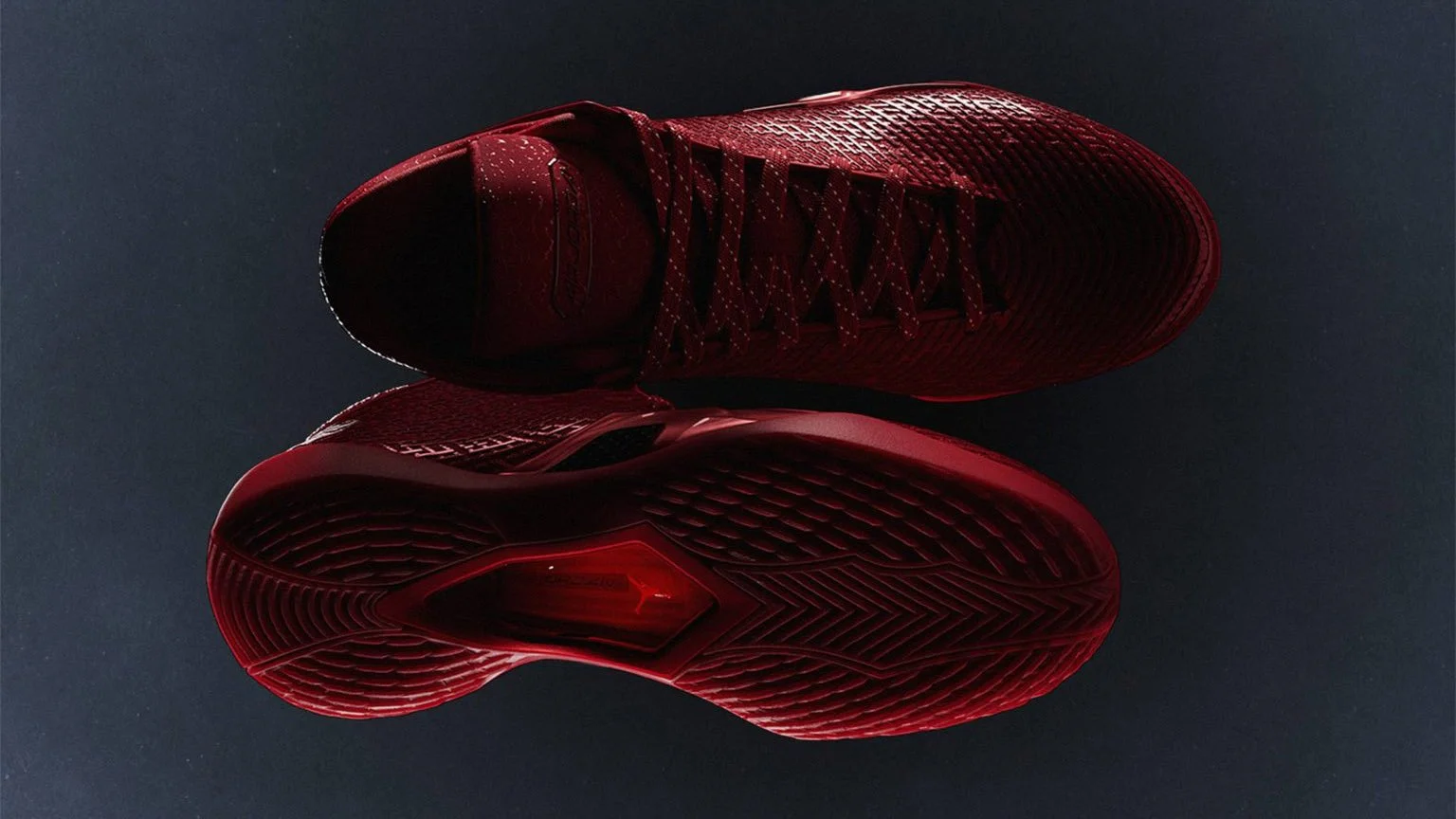
6. Air Jordan 41, the latest flagship model
A few people keep saying it’s necessary to stop the numbered models series ”because Michael’s playing era is way too far”...”because it has lost performance appeal”...”because it doesn’t have off-court appeal” (...), or whatever other reason.
I think the flagship shoe has to be carried over because it still has to be the trailing force of the Brand...a performance Brand that loses it’s performance could eventually survive for a while relying on good times memories and nostalgia but, sooner or later, it’s destinated to die.
A good example of this is how Ferrari is still keeping the F1 team at the apex of its business pyramid. Its indomitable racing soul feeds the desire for its high performance supercars and luxury products while also making the kids dream of becoming part of it, just buying its licensed toys and items.
Just as Jordan’s leading role into his team, the flagship shoe should become once again the performance benchmark in todays market, a spot that is now occupied by some of Kobe Bryant’s remastered models and by a few models made by chinese brand’s such as Li Ning and Anta, which also seem more passionate than Nike/Jordan in pushing innovation with their shoes.
Recently unveiled Air Jordan 41 seems a good step into a more forward directed approach, just following performance rather than recalling past models.
In my opinion, though, this innovation-first metodology has to be preserved along the Years and not to be reduced to a seasonal trend, as it was in the past, when there was not a clear direction for the style of the flagship model.
Speaking of this last model, I also think it lacks of a bit of personality in terms of distinctiveness and functional design elements. The transparent engine hood detail, while not being a new concept (see Melo M7), is quite cool but, being at the bottom of the shoe, is more like of a Sideshow Bob rather than a main design feature. Plus, the carbon fiber micro-zones over the midfoot shank just look like a decorative item without performance purpouse, losing a bit of its meaning.
So, how the flagship model should look like?
In my opinion it should be:
excellent, in terms of design and materials. In the golden era, Air Jordans, as Michael’s game, were the pinnacle in basketball performance and style. Excellence should always be the distinctive mark of Air Jordans.
functional, with the perfect balance of fit, traction, cushioning and stability, as light as possible, not compromising safety and durability.
elegant but also technical looking, combinig aesthetic elements of Jordan’s game. Minimalist design should not lead to anonymous design. The right amount of technical details should always be present as a statement to the performance related nature of the model.
In terms of colourways, while keeping the maximum freedom dictated by general brand’s DNA rules, I would also like to see a more limited amount of them for each yearly model to make each one of them more studied and relevant, maybe working on the design to allow for distinctive colour/material-blockings.
Being the pinnacle of Jordan and Nike innovation, the flagship model should wear the new logo.
These are just some of the ideas I’ve put together in couple of weeks time, if you want to add your vision or share your opinion, be free to do it in the comments below, I will be happy to read it!
Pietro Pellicelli
Foowear designer and creative direction consultant